


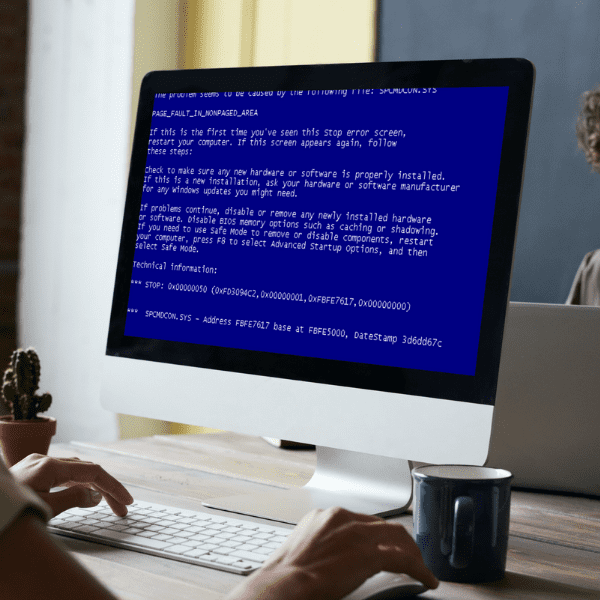
Error codes appear to warn you that a device has a problem, whether it comes from the software or from physical damage.
Errors like this can have a logical or a physical cause, and repeated repair attempts can make things worse. If the files matter, see how hard drive recovery works, starting with a free diagnosis.
Some are much harder to solve than others, but they are all a headache for anyone who just wants to use their PC in peace.
In this article, we list the 14 most common hard disk error codes and their possible causes.
Common hard disk error codes
If you’ve ever had a hard disk failure, you know how quickly it can lead to data loss.
Understanding the type of failure your hard disk has not only helps you identify the problem more easily, but also stops you from making things worse and reducing the chances of a successful data recovery.
Need help working out what’s wrong with your hard disk? Take a look at our list of the most common hard disk error codes and their causes.
1. Disk full
This is one of the most common errors users come across.
If you’ve stored a lot of data on your disk, it may simply run out of space.
A full disk doesn’t damage the hardware, but it can cause write errors, prevent files from being saved properly and make programs malfunction, as well as slowing down your system when it’s packed with photos, videos, documents and other large files.
You may also have installed several applications you don’t need.
A partition that is too small for what you store on it can also trigger this error.
To fix it, you can:
- Scan for viruses and malware and remove them;
- Delete files and programs you no longer need;
- Move data to an external disk to free up space.
2. Predicted S.M.A.R.T. hard disk failure
This message means that S.M.A.R.T. (the disk’s self-monitoring, analysis and reporting technology) has detected a problem and predicts that the hard disk is about to fail.
It usually appears when indicators such as reallocated or pending sectors exceed safe limits, which means the disk is physically degrading.
If you see this error, copy your most important data to another drive immediately and replace the hard disk. If the disk is very slow, makes noises or freezes during the copy, stop and have it assessed by a professional.
3. S.M.A.R.T. Hard Disk Error 301
This error is common on HP computers and appears at startup when the S.M.A.R.T. check detects a hardware problem. It often shows up with little warning and can lead to data loss.
In most cases, it means the disk is genuinely failing, but a poor connection, an outdated BIOS, physical damage, sudden shutdowns or power surges can also be behind it.
If the disk still boots, copy your data first. Then, to rule out a false alarm, you can try the following:
- Check the boot order in the BIOS;
- Reset the BIOS to its default settings;
- Reseat the hard disk (disconnect it and connect it again);
- Do a hard reset (disconnect the power and battery, then hold the power button for 15 seconds);
- If the error persists and the data matters, use a professional data recovery service.
4. S.M.A.R.T. Hard Disk Error 303
This error is also common on HP computers and appears when the hard disk fails the short self-test (Short DST) run by the system diagnostics, often after the computer fails to boot.
It almost always points to a hardware fault. Possible causes include:
- Outdated BIOS (in rare cases);
- Faulty connection or cable;
- Worn read/write heads;
- Bad sectors on the disk surface;
- Physical damage from drops or knocks;
- Unexpected shutdowns while the disk was running;
- Power surges.
To solve this problem, have the hard disk assessed by a professional to find out what is wrong and how extensive the damage is.
It may be tempting to try to fix it yourself, but tools such as Bootrec, fsck, the Windows error-checking tool and CHKDSK put extra strain on a failing disk and can make the data unrecoverable.
5. Hard Disk 1 (3F1)
This error is common on HP laptops and appears when the hard disk is not detected or has failed, or when the startup files are damaged.
These steps can usually rule out simpler causes:
- Do a hard reset;
- Restore the BIOS defaults;
- Run the built-in hardware diagnostics;
- Reseat the hard disk.
6. Boot device not found
This error means that the BIOS can’t find a bootable drive in the system.
It’s usually caused by:
- The wrong boot order in the BIOS;
- A connection problem;
- Malware that has damaged the boot records;
- Physical damage to the hard disk.
To fix it, you can:
- Do a hard reset;
- Restore the BIOS defaults;
- Reseat the hard disk.
7. Primary hard disk error
This error points to a problem with one or more system drives and appears when the drive is damaged or has failed, or when the operating system files are damaged.
If your computer shows this error, have the hard disk assessed by a professional.
Don’t run error-checking tools, as they can cause further damage and make the data unrecoverable.
8. Disk initialization failure
This means the system has found an error on the drive set as the boot drive.
It can happen when the drive is damaged or has failed, or when the operating system files are damaged.
Once again, if you see this error, have the hard disk assessed by a professional.
Running error-checking tools yourself could cause more damage and make your data impossible to recover.
9. Cyclic redundancy check error
This means the data read from the drive failed its integrity check. It’s usually caused by bad sectors on the disk, but it can also come from a faulty cable or connection, or from corrupted files.
If you see this error, we recommend not using error-checking tools on your own.
Instead, have it assessed by a professional, as this error usually points to a hardware problem.
Forcing a damaged disk to keep working only makes the damage worse and can leave the data unrecoverable.
10. I/O device error
An I/O device error means that Windows couldn’t complete a read or write operation on the drive.
It can be caused by a faulty cable, USB port or driver, but also by a damaged or failing drive.
Try another cable and port; if the error persists, as with the other errors in this article, don’t keep trying on your own and have the drive fully assessed by a professional.
11. Disk read error
This error means there is a read error on the drive, usually because the hard disk is damaged or because the startup files are corrupted.
Again, to identify and solve the problem, the drive needs to be assessed by a professional.
12. Windows error codes
When Windows runs into certain serious problems, it stops and displays diagnostic information in white text on a blue background, which is why these are known as blue screen errors.
These error codes start with “STOP 0x”, followed by a combination of letters and numbers that identifies the cause of the error.
If you get one of these errors, try restarting the computer. If that doesn’t solve it, look up the specific code to find out where the problem comes from.
If the code points to a hardware problem, stop using the drive immediately and have it assessed by a professional.
13. The parameter is incorrect
This is one of the most common errors on external hard disks and is usually caused by a power problem, a faulty USB port or cable, or disconnecting the drive without ejecting it first.
Sometimes connecting the drive to another computer is enough. If that doesn’t help, take the drive to a professional for assessment.
14. The request failed due to a fatal device hardware error
This error means the device couldn’t be accessed because of a hardware fault. It usually appears when the drive is damaged or failing, and sometimes because of a faulty cable or enclosure.
Restarting the computer or changing the cable and port sometimes helps. If not, the drive must be assessed by a professional.
In this case, as with the others on this list, we recommend not trying to fix the problem yourself, to avoid further damage and keep the data recoverable.
How do I recover data from a hard disk with an error code?
Whatever error code your hard disk shows, a professional data recovery service gives you the best chance of getting your data back.
Here at Bot, for example, we specialize in recovering data from hard disks of all makes and models.
Your disk will be handled by highly trained professionals in a Class 100 (ISO 5) cleanroom, and we offer free collection of your device (islands excluded).
If you prefer, you can also drop off your device at one of our locations.
And if you have any questions, you can get in touch with us 24/7 on Instagram and X (Twitter).
Read next
Conclusion
In this article, you’ve learned about the 14 most common hard disk errors. Some are caused by software (system) problems, others by hardware (physical) damage.
Whatever caused your hard disk to fail, we can help.
Our data recovery experts at Bot are equipped to work on hard disks of any make or model.
Start your recovery today and become one of our more than 200,000 cases!


