


One question our customers often ask is how to remove the hard disk or SSD from a desktop computer or laptop. That’s why we decided to write a detailed guide, so you can do it without making mistakes.
When the files matter or the fault is physical, the safest route is a lab: see our hard drive data recovery service.
There are times when a storage device has to come out of the computer, whether to replace it, for maintenance or to send it to a data recovery company. Knowing how to remove it properly helps you avoid damaging it.
Many people think it’s a difficult job, but it’s simpler than it sounds. Even so, if you don’t feel confident following the steps, we recommend asking a qualified technician to do it for you.
Here is everything you need to know to remove a hard disk or SSD correctly.
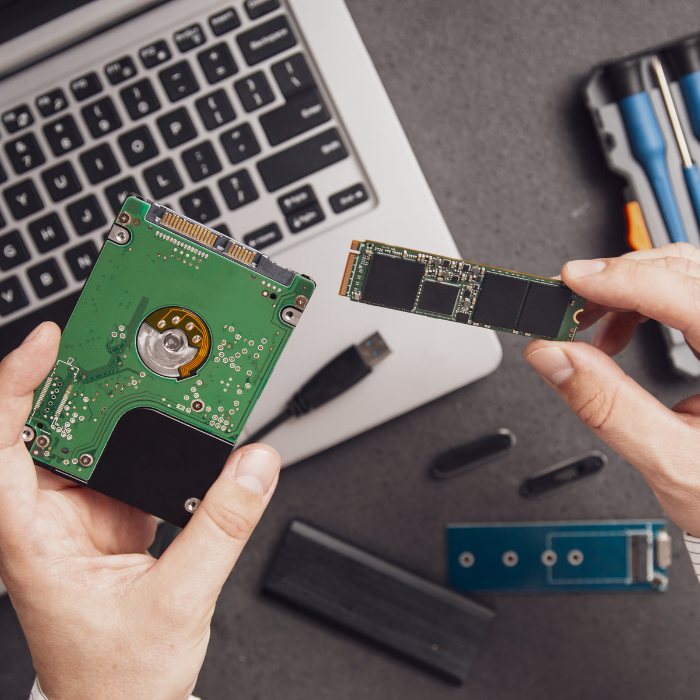
What is a hard disk?
A hard disk is a data storage device that has been used in desktop computers and laptops for decades and has evolved a great deal over the years.
Everything stored on it stays there even when the computer is switched off, which is why it is used to keep the operating system, programs, photos, videos and other files.
There are also external hard disks, which do the same job but sit outside the computer in their own enclosure and are usually connected by USB only when you need to copy or access files.
What is an SSD?
SSDs (solid-state drives) are often seen as the successor to traditional hard disks because they perform much better.
Their main job is also to store data, but because they use flash memory and have no moving parts, they stand out in several ways: they read and write faster, use less power, are more resistant to knocks and are completely silent.
External SSDs also exist, although they are not yet as common as external hard disks.
How do I remove the hard disk or SSD from a desktop PC?
To show that removing a hard disk or SSD from a desktop computer is simple, we’ve put together a quick step-by-step guide that anyone can follow.
Bear in mind that this is a general guide and your computer may be slightly different. If in doubt, ask a professional for help.
Here are the steps:
Step 1: Shut down and unplug your computer
It may seem obvious, but it’s an essential step to avoid getting hurt or damaging the computer and its components. Before touching anything inside, touch a bare metal part of the case to discharge any static electricity.
Step 2: Open the case
Removing the side panel of a PC case isn’t difficult, but you will usually need a Phillips screwdriver to undo the screws that hold it in place. Keep the screws somewhere safe so you don’t lose them, as you’ll need them to put the panel back on.
Step 3: Locate the hard disk or SSD
If you’ve ever seen a hard disk or SSD, you’ll easily spot it inside the case. If not, look up some pictures online first so you don’t confuse it with another component.
Step 4: Disconnect the cables
A SATA hard disk or SSD is connected by a data cable and a power cable. Identify both and unplug them gently, pulling by the connector and not by the wires. M.2 SSDs plug straight into the motherboard and have no cables.
Step 5: Remove the hard disk or SSD
Undo the screws or release the clips that hold the drive in its bay (or the single screw that holds an M.2 SSD) and slide it out carefully, without forcing it. Avoid touching the circuit board and never drop the drive, especially a hard disk.
How do I remove the hard disk or SSD from a laptop?
On a laptop the process is slightly different and varies from model to model. Here are the general steps.
The same advice applies: if you feel you need to, ask a professional to remove the hard disk or SSD for you.
Step 1: Switch off your laptop
The laptop must be completely shut down (not in sleep or hibernation) and unplugged from the charger to avoid accidents and damage. If the battery is removable, take it out; if it’s internal, disconnect its cable from the motherboard as soon as the cover is off, if your model allows it.
Step 2: Remove the laptop’s bottom cover
Turn the laptop upside down on a soft, clean surface, take a small Phillips screwdriver and remove all the screws from the bottom cover. Some models also have clips, so lift the cover gently with a plastic tool.
Step 3: Locate the hard disk or SSD
The drive is usually easy to find inside the laptop. If you’re not sure what it looks like, search online for pictures of laptop hard disks and SSDs so you don’t confuse it with another component.
Step 4: Disconnect the cables
Remove it carefully, disconnecting any cable or connector gently so you don’t damage the parts. Then put the bottom cover back on, so you don’t lose the screws and the other components stay protected.
Step-by-step: physically replacing the hard disk
- Remove the laptop’s bottom cover.
- Locate the hard disk and disconnect it from its connector or cable.
- Remove the screws that hold the hard disk’s caddy or bracket in place, and then the screws that attach the disk to the caddy.
- Fit the new SSD in the caddy, put it back in the hard disk bay and reconnect it.
- Check that everything is firmly in place before closing the cover.
Step-by-step: installing the operating system
You only need to do this if the operating system was installed on the hard disk or SSD you removed:
- Create a bootable USB installer for your operating system on another computer and plug it into the laptop.
- Turn on the laptop and press the key that opens the BIOS/UEFI setup (usually F2, F10, F12, Del or Esc, depending on the brand).
- Change the boot order so that the USB stick is the first boot device.
- Save the BIOS settings and exit. The laptop will restart from the USB stick; follow the on-screen instructions to install the operating system on the new drive.
Read next
Conclusion
Not that difficult, was it? If you wanted to know how to remove a hard disk or SSD, now you know.
And if your next step is to recover the data stored on one of these drives, we can help with that too. Bot works in professional data recovery and has everything you need to get your information back: speed, security and efficiency.
Any questions? Contact us to find out how to send us your hard disk or SSD for recovery.


