


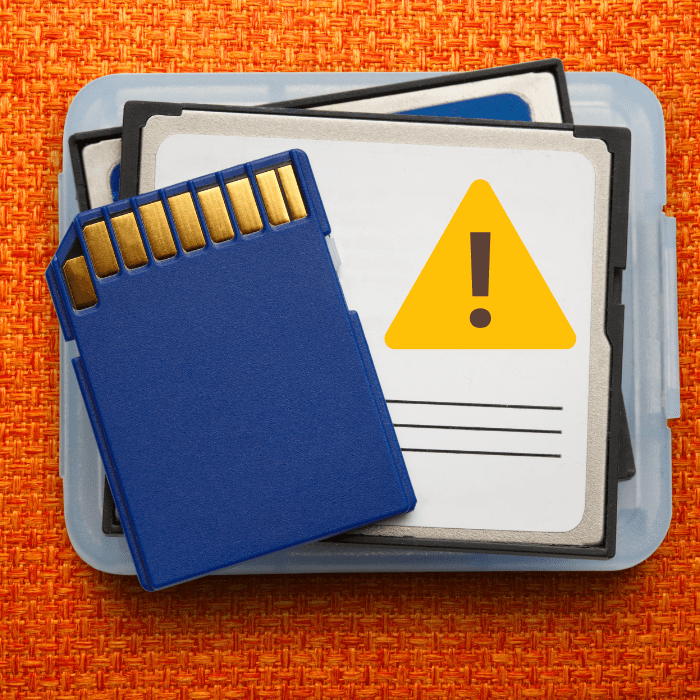
A memory card is a storage device used to add storage space to digital cameras, video cameras, smartphones and other devices.
Errors like this can have a logical or a physical cause, and repeated repair attempts can make things worse. If the files matter, see how memory card recovery works, starting with a free diagnosis.
Memory cards can hold huge numbers of photos, videos, documents and all kinds of other files.
They also come in various formats, depending on what they’re used for: SD, SDHC and SDXC cards, microSD cards, CompactFlash (CF), Memory Stick, xD-Picture Card and so on.
However, like any external storage device, memory cards and SD cards can run into errors for a variety of reasons.
In this article, we look at the most common memory card errors and safe ways to fix them.
Why do SD cards fail?
Like other storage devices, memory cards are prone to a range of problems.
SD cards are very delicate and need to be handled with great care.
Even a little carelessness can seriously damage an SD card, so keep it in a proper case whenever it’s not in a device.
Besides mishandling, there are other reasons why an SD card may fail.
For example: removing the card without ejecting it properly (or without switching off the device it’s in), inserting it into devices that may be infected with viruses, using faulty card readers, and switching off the device while it’s writing to the card.
Causes of memory card errors
There are several reasons why a memory card may show errors.
They include incorrect formatting, a damaged file system that shows up as RAW, a faulty card reader, viruses or malware, a corrupted card structure, sudden power loss and interrupted writes.
Below, we explain each of the most common causes:
The memory card isn’t formatted correctly
If you try to open your memory card and get a message such as “You need to format the disk in drive E: before you can use it. Do you want to format it?”, Windows can’t recognize the card’s format. If you want to keep the files, click Cancel.
This can be caused by:
- A serious virus infection on the SD card;
- Formatting the card the wrong way, or in an incompatible device;
- Frequent formatting in different devices;
- Using the SD card in virus-infected devices.
The file system is damaged or shows up as RAW
When an SD card becomes RAW, the operating system won’t let you open it and asks you to format it, showing the message “You need to format the disk in drive X: before you can use it” — or something similar — every time you try to access the files on it.
That’s because RAW isn’t a file system: it’s how Windows labels a drive whose file system it can’t recognize. An SD card usually turns RAW because:
- The SD card’s file system is damaged or corrupted;
- The memory card’s file system is missing;
- The file system isn’t recognized by the computer;
- The SD card was formatted with an incompatible file system.
These problems can be caused by viruses, incorrect use of the storage device, failed formatting and so on.
Faulty card reader
To read the data on an SD card, the card reader also has to work properly. If the reader is damaged, the data can’t be read.
To rule this out, try the SD card in another reader or device.
Virus or malware infection
If you insert the SD card into an infected device, the card can become infected with viruses or malware too. This can damage the files and make the data unreadable.
In addition, some malware (ransomware) encrypts the data on the card, and the attackers then demand a ransom to unlock your files.
Corrupted card structure or corrupted memory card
When a memory card is corrupted, you can’t access the files, and they may seem to have disappeared because the SD card can’t be opened or isn’t recognized by your computer.
Some signs that your memory card is corrupted:
- Missing files;
- The card isn’t recognized;
- Error messages: when you insert the card and try to open it, you get alerts such as “Access is denied” or “Windows was unable to complete the format”;
- Unknown or garbled files;
- You can’t read and/or write data;
- The device using the card malfunctions;
- The card appears blank: a corrupted SD card that still holds data can show up as empty on your device.
Sudden power loss when removing the card with the camera switched on
An unexpected loss of power — caused, for example, by removing the memory card while the camera is still on — can logically damage the card.
If the card has actually suffered logical damage, when you try to open it on your computer you’ll get a message asking you to format it. Don’t: formatting won’t give you access to the data.
Also, if you look at the memory card in Disk Management or in its Properties, you’ll see that it shows up as RAW instead of the usual FAT32, exFAT or NTFS format.
Switching the camera off while it’s writing to the card
Switching the camera off while it’s saving a photo or recording a video interrupts the write, which can corrupt the file being saved and the card’s file system.
So always wait until the camera has finished writing to the card before switching it off or removing the card.
What to do when your memory card fails
If your memory card is showing an error, here are some steps you can take to fix the problem:
Reinsert the memory card correctly
The first thing to try is simply removing the SD card and reinserting it correctly.
To do this, switch off your camera or smartphone, remove the memory card and carefully insert it back into the device.
If the card still shows errors, move on to the next method.
Connect the memory card to another device or computer
Sometimes memory cards show errors because of compatibility problems.
To check for compatibility problems, connect your memory card to your computer or another device.
If it’s a compatibility problem, you’ll need to use a card that’s compatible with your device or keep using the card only in devices where it works.
However, if your memory card is corrupted and holds important photos, documents or videos, it’s best to recover the data first.
Fix memory card or SD card errors with CHKDSK
Before using this method, recover your data first: CHKDSK writes to the card and can delete or damage files while it repairs the file system.
Once your photos, videos, audio files and documents are safe, follow the steps below to try to repair the card with the CHKDSK command:
- Connect the corrupted SD card to your computer and type “cmd” in the Windows Start menu;
- Run Command Prompt as administrator;
- Type
chkdsk F: /f(replacing F with the corrupted memory card’s drive letter); - Press Enter;
- Wait for the scan to finish and repair the card’s errors.
Format the memory card
The last resort for fixing SD card or memory card errors is to format the card. Before you do, make sure you’ve recovered the data on it, because formatting erases all the files.
To format the card:
- Type Control Panel into the Windows search box;
- Select “Administrative Tools” (or “Windows Tools”);
- Click “Computer Management”;
- Then click “Disk Management”;
- Right-click the SD card that isn’t being recognized;
- Select “Format” and confirm to finish formatting.
Read next
Conclusion
Like external hard drives and other storage devices, memory cards can suffer damage and serious failures.
This can happen when the card is formatted incorrectly, when its file system turns RAW or when it is infected by a virus.
Memory cards can also show errors when their structure is corrupted or when they lose power suddenly (for example, when removed while the device is on or without being ejected properly).
Finally, switching off the device while it’s writing to the card can also cause errors.
Sometimes simple solutions are enough to fix memory card errors, such as reinserting the card correctly or connecting it to another device.
In other cases, more drastic measures are needed, such as running CHKDSK or formatting the card — always after recovering the data.
To recover the data on your memory card safely, turn to a company that specializes in data recovery, such as Bot.
Our experts work in a specialized laboratory with its own Class 100 (ISO 5) cleanroom — a particle-controlled environment — and the right equipment to work on your card without causing further damage.
We work with memory cards of every model, brand and file system, whether the card has been dropped, burnt or corrupted, or the files were simply deleted.
Standard diagnosis is free and takes up to 48 hours, with faster options of up to 24 or 12 hours.
Finally, collection of your memory card is free anywhere in Portugal (islands not included).
Start your recovery with us today and become one of our more than 200,000 cases!


