


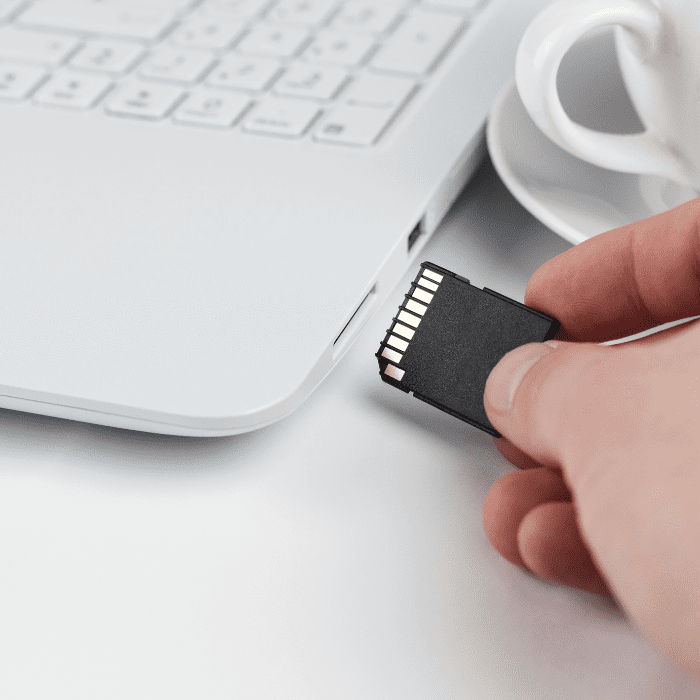
Technology has made life more practical. We no longer need piles of paper files for our documents or dozens of photo albums to keep our memories.
If your memory card is still not recognized, the fault may be physical and every new attempt counts. Before trying again, see how SD card recovery works, starting with a free diagnosis.
Today, much of that is simply stored on SD cards.
So what do you do when your SD card isn’t recognized by your phone or by Windows 10/11? And why doesn’t it show up in the first place?
It’s a worrying situation, but there’s no need to panic: there are several ways to get your SD card working again, and that’s what we’ll look at in this article.
Why is the SD card not showing up?
To fix an SD card that your phone or computer won’t recognize, it helps to know what’s causing the problem. That way, you’ll solve it faster.
These are the most likely causes:
Connection problems
This is the simplest reason why an SD card isn’t recognized by a phone or computer.
Fortunately, if the problem is the connection, it’s easy to fix. Before trying anything more drastic, remove the SD card, gently clean its contacts and insert it again.
If your laptop doesn’t have a built-in SD card slot, you’ll need an adapter or card reader.
However, if the adapter is faulty, the memory card won’t be recognized.
In that case, try another card reader – making sure it’s compatible with your type of SD card.
The files on the SD card are hidden
Another possible reason why the SD card doesn’t show all your files is that some of them are hidden.
In this case, the SD card is detected, but the files you want may not be visible.
In Windows, you can easily show hidden files on your SD card by changing a setting.
With the SD card connected, open File Explorer and go to the card.
Then, on the “View” tab (in Windows 11, “View” > “Show”), select the option to show hidden items.
Refresh the window and check whether the missing files now appear.
Some apps also save large videos as several segments instead of a single file. So if you’re looking for a large file, you may not find it on the SD card under its usual name.
You can search for these segments manually. For example, if you can’t find an .mp4 video on your SD card, try searching for files with the .m4s extension.
If the files on the SD card don’t show up on your phone, use a file manager app.
Most modern file managers (such as Files by Google, Solid Explorer or Ghost Commander) can show hidden files.
Just open the app’s settings and turn on the option to show hidden files on your Android phone.
The SD card is locked
A very common problem that can stop you from using your SD card is the physical lock switch on the card, which can be moved accidentally.
Full-size SD cards (and microSD adapters) have a write-protect switch that only allows read operations. When it’s on, you can’t save, delete or change files on the card.
Missing or deleted data
If the SD card is recognized but doesn’t show any files, it may have been formatted or the files may have been deleted by mistake.
In that case, you’ll need a data recovery solution. Stop using the card so that the deleted data isn’t overwritten.
The SD card is corrupted
Another reason why an SD card isn’t recognized is corruption of the storage.
Whatever its cause, corruption can make the file system inaccessible.
How to fix an SD card that isn’t recognized in Windows 10/11
Here are some simple ways to fix an SD card that Windows 10/11 doesn’t recognize:
Use a different USB port
When the system doesn’t recognize your microSD card, the USB port is the first thing to check. Try another port before moving on to more drastic solutions.
Check whether the PC or the card reader is faulty
If your SD card can’t be read through just one of your computer’s USB ports, the problem may be with the computer.
Try the card in another computer. You can also test a different SD card in the same reader to see whether the reader is the problem.
Disable write protection
Full-size SD cards usually have a small switch on the side for write protection. Slide it to the unlocked position and the card should work normally again.
If the card has no switch but is still write-protected, follow these steps:
- Press Windows + R to open the Run window;
- Type
diskpart, click “OK” and accept the administrator prompt; - Type
list diskand press Enter; - Identify the SD card by its size;
- Type
select disk 2(replacing 2 with the SD card’s number) and press Enter; - Type
attributes disk clear readonlyand press Enter; - Type
exit, remove the card and insert it again; - If the card is still write-protected, it may be failing: many cards switch to read-only mode at the end of their life to protect the data;
- In that case, copy your files to another drive straight away and don’t try to format the card.
Change the SD card’s drive letter
Your microSD card won’t show up in File Explorer unless it has a drive letter.
To assign a drive letter to your SD card:
- Open Disk Management (right-click the Start button and select “Disk Management”);
- Find the SD card that isn’t showing up;
- Right-click its volume;
- Select “Change Drive Letter and Paths”;
- Click “Add” (or “Change” if it already has a letter);
- Choose a letter from the list that isn’t used by another drive and click “OK”.
- Identify the SD card by its size;
Run CHKDSK on the SD card
The CHKDSK command is a good way to find and fix file system errors on an SD card and to mark bad sectors so they’re no longer used.
It can therefore help when the card is detected but can’t be opened. Keep in mind that, while repairing, CHKDSK may remove damaged files, so if the data is important, recover it first. To run it:
- Check which drive letter the SD card has in File Explorer or Disk Management;
- Make sure you have a copy of any important data on the card;
- Open Disk Management (right-click the Start button and select “Disk Management”);
- Press Windows + R;
- Type cmd;
- Press Ctrl + Shift + Enter to open Command Prompt as administrator;
- Type
chkdsk E: /f(replacing E: with the SD card’s letter); - Press “Enter”.
Reinstall the SD card driver
A common reason why the system doesn’t recognize an SD card is a faulty or outdated driver.
Follow these steps to reinstall the SD card driver:
- Connect your SD card to the computer;
- Open Device Manager (right-click the Start button and select “Device Manager”) and expand “Disk drives”;
- Find your SD card;
- Right-click it and select “Uninstall device”;
- Go to “Action” > “Scan for hardware changes”. Windows will reinstall the driver for the card.
Remove viruses or malware
If the SD card’s files have disappeared, a virus or malware may have hidden them. In this case, scan the card and restore the hidden files by following these steps:
- Connect the SD card and scan it with your antivirus;
- Open the Start menu;
- Type cmd in the search bar;
- Press “Enter”;
- Right-click “Command Prompt”;
- Select “Run as administrator”;
- Type
attrib -h -r -s /s /d E:\*.*(replacing E: with the SD card’s letter) and press Enter. This makes the files hidden by the virus visible again.
Format the SD card
The last resort to make an SD card usable again is to format it. Remember that formatting erases all the data, files and documents on the card, so if you need them, recover them before formatting.
- Press Windows + D to go to the desktop;
- Press Windows + E to open File Explorer;
- Right-click your SD card;
- Select “Format”.
Recover data from an unrecognized SD card with Bot
At Bot, we specialize in SD card recovery, whatever the brand, file system or model.
Whether your card isn’t recognized because of cracks, fire damage, corruption or deleted files, we can help you try to get your data back.
What’s more, our analysis and quote are free of charge, even if your card has already been examined by other companies.
Conclusion
SD cards are widely used today, mainly to store files and data on smartphones.
However, practical and efficient as they are, these cards are not immune to faults and can run into problems – for example, not being recognized by phones or PCs.
This can happen for several reasons, including connection problems and corruption.
To fix the problem in Windows, you can try a different USB port, check whether the card reader is faulty, disable write protection or change the drive letter.
You can also run CHKDSK, reinstall the card’s driver, scan it for viruses and malware or, if nothing else works, format the card – which erases the data stored on it.
If your SD card has already been formatted, don’t despair: at Bot, we can help you try to recover your data.
We are data recovery specialists, with more than two decades of experience and more than 200,000 cases.
For your convenience, we collect your SD card free of charge (islands not included).
Start your data recovery with us now: we have a 96% success rate!


