


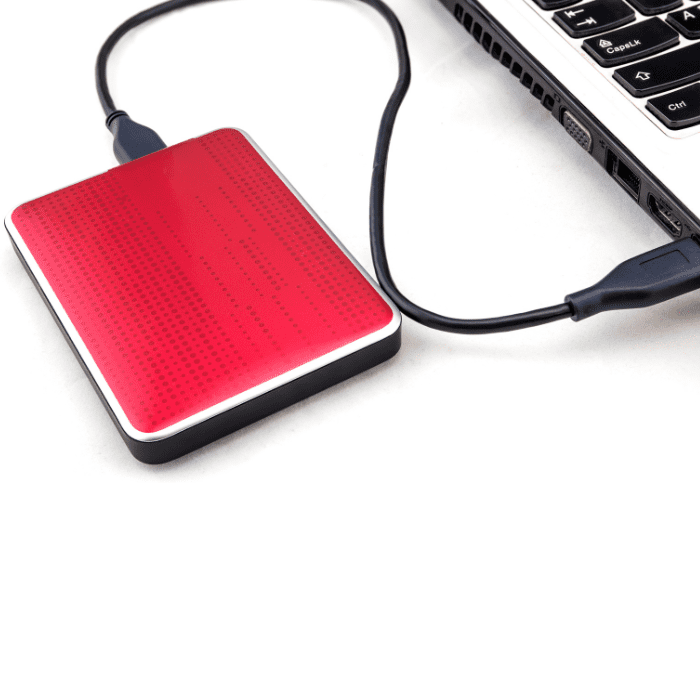
If you’re reading this, you probably need to repair your external disk. If it doesn’t respond when you plug it into a USB port, or you can’t open your files, something is wrong.
Errors like this can have a logical or a physical cause, and repeated repair attempts can make things worse. If the files matter, see how external hard drive recovery works, starting with a free diagnosis.
External disks are more and more popular because they are so practical, and many of us end up relying heavily on what we keep on them.
If that’s your case, don’t panic: there are several possible solutions, and in many cases even very important files can still be recovered.
In this article, we go through some of them. Let’s get started.
What can cause external disk problems?
Before we look at how to repair an external disk, it helps to understand why problems happen. Are they common?
Not especially. External disks are generally reliable, and there are good brands on the market. Even so, faults do happen and can make it hard to access your files.
Why does this happen? There are several reasons; these are the main ones:
Malware
Many computers still have no antivirus protection, and because an external disk is plugged into different machines, it is easily exposed to infections.
Malware can corrupt or encrypt the files on the external disk and make them inaccessible.
Hardware fault
The external disk itself may be failing (worn heads, bad sectors, a damaged USB board), so the computer may not recognize it or may be unable to read and write files.
File system corruption
The file system on the external drive may be damaged, so the computer can’t recognize the drive’s contents or simply can’t open the files.
This can have several causes, including unplugging the drive without ejecting it, power cuts and physical problems, such as a faulty USB connector or a loose internal connection.
Is it possible to repair an external disk?
So, is it really possible to repair an external disk?
If you’re not comfortable with this kind of technology, repairing the drive yourself can be quite a challenge. However, there are some very simple things you can try.
If they don’t help you get your external disk or its files back, the best option is to go to a professional.
Remember that storage devices, and external disks in particular, often hold very important data.
A single irreversible step can mean losing all those files. So, if you’re not sure what you’re doing, contact a professional before trying anything.
Below are some simple solutions you can try at home, depending on the problem your disk has.
What should I do when the drive doesn’t work?
If your external disk isn’t working, don’t panic. You don’t necessarily have to repair it or take it to a service center straight away, as there are a few very simple checks you can do yourself.
Here are two ways to check whether your external disk can work again.
Try another USB port or another computer
If you don’t know whether the problem is the external disk or the USB port, try connecting the drive to another USB port, another cable or another computer.
If it’s recognized, copy your important files to another drive right away.
If it still isn’t detected, the problem is probably in the drive itself, and you will need a different approach to recover the data.
Recovering data from a corrupted external disk
If the drive is detected but the data is inaccessible, a data recovery program can scan it and copy the files it finds to another drive.
There are two ways to go about it: download a data recovery program and try it yourself, or send your external disk to professionals.
When repairing an external disk gets more complicated (for example, if it isn’t detected, makes noises or is very slow), leaving it to professionals gives you the best chance of recovering your data.
Checking the file system
What if your disk is connected and recognized by the computer, but you can’t open the files? There are a few options.
One of them is CHKDSK. Open the Start menu, type CMD, right-click Command Prompt and choose “Run as administrator”.
Then type chkdsk G: /f, replacing G with the letter of your external disk in File Explorer. Make sure you have the right letter before running the command.
Press Enter. CHKDSK will try to fix the file system errors, but to do so it may delete or truncate damaged files, and it should not be used on a disk with physical faults. If the data matters, recover it with a data recovery program first. If this doesn’t work, there are other ways to repair an external disk.
How do I repair a corrupted external disk?
If your external disk still isn’t working properly, the next step is to repair it. Bear in mind that the methods below erase or can put the data on the drive at risk, so use them only after recovering your files or if you don’t need them:
Formatting
- Connect the external disk to your computer.
- In File Explorer, right-click the drive.
- Select Format.
- Choose the file system (NTFS for Windows only, exFAT to use the drive on both Windows and Mac).
- Click Start and confirm.
This creates a new, empty file system on the drive. It often solves the problem, but it deletes all the files, so only do it if the data is already safe elsewhere or you are prepared to lose it.
Partition management software
Another option is to use a partition management program. Here we use EaseUS Partition Master as an example. After installing it, follow these steps:
- Connect the external disk to your computer.
- Open EaseUS Partition Master (the free version is enough).
- Right-click the partition on your drive.
- Click Check Partition and select the options Check partition properties, Call Windows Chkdsk.exe to fix errors and Surface test.
- Start the check so the program can fix the errors it finds.
- Click OK when it finishes.
This check doesn’t format the drive, but it relies on CHKDSK to fix errors and the surface test reads every sector, so it carries the same risks: if you have important files, recover them first.
How can I repair a corrupted external disk without losing data?
Whenever there is important data on the drive, the priority is to get it back before any repair. Below are two other ways to fix the drive, and when each one makes sense.
Partition management software
Partition management software can also rebuild the drive from scratch.
EaseUS Partition Master, for example, can do this, but the process below erases all the information on the drive, so only use it once your files are safe.
If you have the program, follow these steps:
- Check the disk and repair it if it’s corrupted;
- Wipe the data from the drive;
- Leave the space unallocated;
- Create a new partition in Disk Management.
This process is a bit more complex. If it doesn’t work, there is another option.
Using the Command Prompt (DiskPart)
You can also rebuild the drive’s partitions with DiskPart in the Command Prompt. As explained above, open the Start menu, type CMD and run Command Prompt as administrator.
Then type the following commands, pressing Enter after each one:
diskpartlist diskselect disk X(X is the disk number shown bylist disk, not the drive letter; check the size carefully so you don’t select the wrong disk)cleancreate partition primaryexit
Very important: clean erases the partition table of the selected disk, so all your files become inaccessible, and you will then need to format the new partition (format fs=exfat quick and assign, before exit) before using it. Only use this method once your data has been recovered or if you don’t need it. If you run it by mistake, stop using the disk and contact a data recovery specialist.
Read next
Conclusion
As you have seen, external disks can fail for different reasons, and there are different ways of repairing them.
Some methods can give you access to the drive and its files again without formatting, but always recover the data before using any method that erases the drive.
However, if the disk doesn’t respond to the simplest methods, or if the content is very important, it’s best to leave it in the hands of professionals.
In some cases, the problem may even be in the computer rather than the drive, which calls for a more technical assessment.
We hope this article helps you repair your external disk. If you have any doubts or concerns, contact a team of qualified professionals.
If you still can’t solve the problem after trying, or you need data recovery, Bot can help.
You have two options: bring your device to one of our locations or send it to us, so that our technicians can diagnose the problem and give you a quote for the recovery.
Just fill in the form on our website and choose how you want to get the device to us.
There are two ways: free collection (islands excluded) or drop-off at one of Bot’s reception points in Lisbon, Coimbra, Porto and Braga.
Bot has reception points in Lisbon, Coimbra, Porto and Braga. You can find the one nearest to you at this link. After filling in the form, you can drop off the device there.
Want to see more of Bot’s work? Follow us on social media:


