


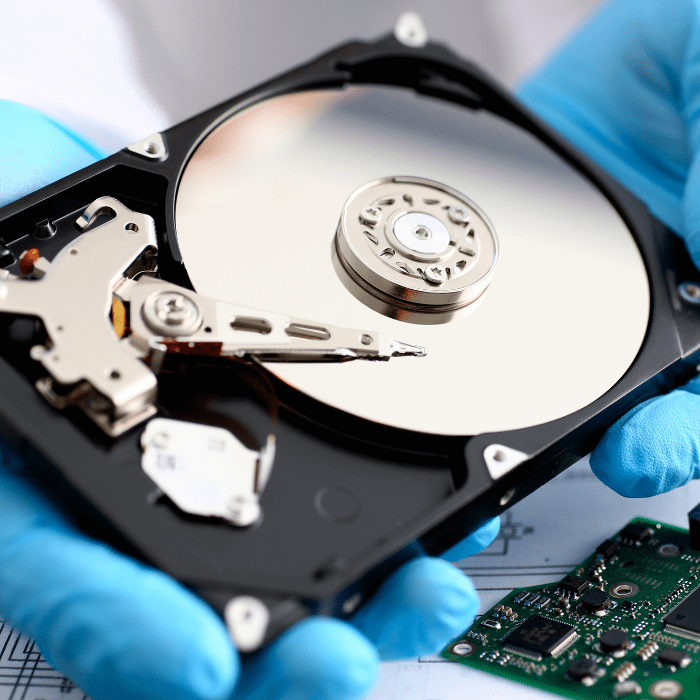
When you connect an external hard drive, you normally hear a soft whirring sound: the drive is spinning up so the system can access the stored data.
If your external drive is still not recognized, the fault may be physical and every new attempt counts. Before trying again, see how external hard drive recovery works, starting with a free diagnosis.
That’s because hard drives (internal or external) store data on platters and use read/write heads to read and write it. As soon as you connect the drive, the platters start to spin.
But if your external drive doesn’t spin, it isn’t working properly and the system won’t be able to detect it. This can happen for several reasons.
In this article, we look at why an external hard drive may not spin and what you can safely do about it.
Why isn’t my hard drive spinning?
Several faults can stop the platters of an external hard drive from spinning.
The first is damage to the printed circuit board (PCB). Another is a head failure, with the heads stuck to the platters. Finally, the spindle motor itself may have failed.
Let’s take a closer look at each of these causes.
Electrical fault on the printed circuit board (PCB)
When the hard drive powers up, current flows through the PCB to the spindle motor, which then spins the platters.
So if the PCB is damaged, the motor won’t start and the drive won’t spin.
In some cases, the PCB burns out the moment you connect the drive, and you may even see smoke or smell burning.
This is a sign of a short circuit. The data becomes inaccessible, although it usually remains intact on the platters. Don’t connect the drive again: the repair has to be done in a lab.
Read/write heads stuck to the platters
In a hard drive, data is recorded on magnetic platters, and the read/write heads fly a tiny fraction of a millimeter above them.
The heads should never touch the platters – if they do, the result is a head crash.
Sometimes a head crash isn’t serious enough to stop the drive completely: it keeps spinning, but you hear a ticking, scraping or clicking noise.
In other cases, the heads stick to the platter surface so firmly that the platters can’t spin at all.
Seized spindle motor
Like every internal component, the hard drive’s motor is extremely delicate and easily damaged.
The motor of an external drive can fail because of a knock or a fall, or simply through wear – hard drives have a limited lifespan.
The motor spins the magnetic platters, usually at 5,400 or 7,200 RPM in external drives. If it seizes, the drive can’t spin.
What are the symptoms of a hard drive that won’t spin?
When a hard drive stops spinning, the signs that something is wrong are usually clear. Here are the two main symptoms.
Your computer doesn’t recognize the hard drive
An external drive can only work if its platters spin. When they stop, the computer doesn’t recognize the drive and the data becomes inaccessible.
In this situation, no data recovery software can help, because the program can’t read a drive that isn’t working.
You can’t recover the data from the hard drive
If you try to recover data from an external drive that won’t spin, you’ll get an error or the drive simply won’t appear. In this situation, the best thing to do is send it to a specialist data recovery company.
What can I do about a hard drive that won’t spin?
Here are the checks you can safely do yourself, and the cases that need a lab.
Option 1: Check the power supply and cable
First, try another power source: if the drive has its own power adapter, test another compatible adapter or socket; if it is powered by USB, try another port or a powered USB hub.
You can also replace the cable that connects the external drive to the computer to rule out a faulty cable.
Option 2: Rule out the computer before suspecting the PCB
Sometimes simply connecting the external drive to another computer solves the problem.
That happens when the fault was in the first computer – a USB port that doesn’t supply enough power, a different voltage level or software settings. If the drive doesn’t spin on any computer, the PCB is likely damaged. Don’t swap it for a board from another drive yourself: modern drives store unique data on the PCB’s ROM chip, which has to be transferred in a lab.
Option 3: Stuck heads – a job for a clean room
Stuck heads cause serious problems, such as a clicking drive or, as in this case, an external drive that won’t spin.
When a drive is not in use, the heads should rest in the parking area (ramp or landing zone). If they stay stuck on the platter surface, the drive can’t spin – and the only way to confirm and fix this is to open the drive, which can only be done in a clean room.
If you suspect stuck heads, here’s what to do:
- Step 1: Stop powering the drive. Each attempt forces the motor against the stuck heads and can damage the platters.
- Step 2: Don’t open the drive. A single speck of dust or a fingerprint on the platters can destroy the heads and the data, and freeing the heads requires specific tools.
- Step 3: Send the drive to a data recovery lab, where technicians release the heads in a clean room, check whether they are damaged and replace them with compatible donor heads if needed.
- Step 4: Once the data has been copied to a new drive, don’t keep using the original one: a drive that has had stuck heads is no longer reliable.
Warning: a hard drive should only ever be opened by qualified technicians in a clean room. Opening it at home exposes the platters to dust and dirt and can cause irreversible damage and permanent data loss.
Option 4: Seized spindle motor – a job for a lab
In a working external hard drive, the platters spin thanks to the spindle motor.
If the spindle motor is seized or the spindle is damaged, the external drive won’t spin when you connect it.
When the motor or spindle is physically damaged, the usual solution is to move the platters to a compatible donor drive (a platter transplant) or to replace the motor. Both procedures require professional tools and a clean room.
That’s why you should send your hard drive to a specialized company instead of trying to repair it yourself.
Read next
Conclusion
If the simple checks above haven’t worked, turn to professional data recovery services, such as Bot, to recover the data from your external drive.
We have a Class 100 (ISO 5) clean room, where our highly qualified technicians work in a dust-free, air-controlled environment to open your external drive safely.
We also have extensive experience in recovering data from damaged or broken external drives.
Besides the quality of our work, we care about your convenience and how urgently you need your data back.
With a 96% success rate, we are ready to help: Start your data recovery with us today!


