


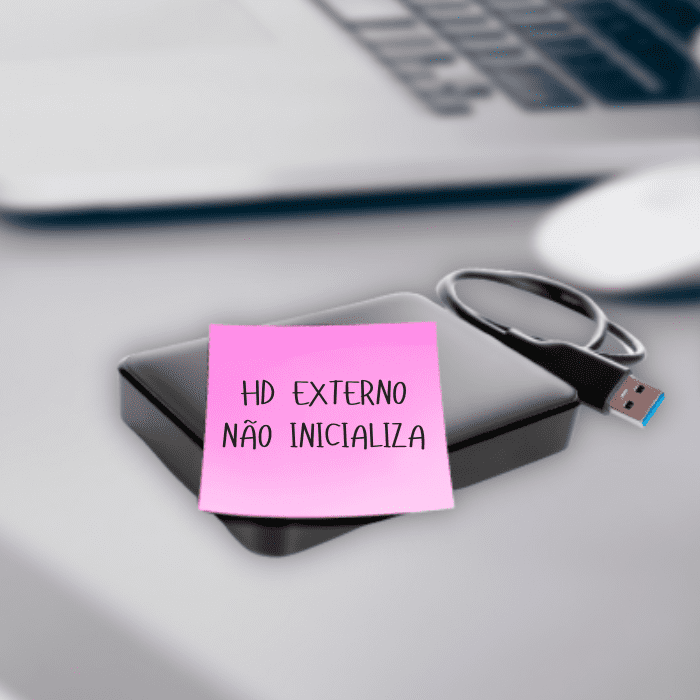
External drives are extremely useful for anyone who works with a large number of files, especially for keeping backups, since many people do not fully trust cloud storage.
If your external drive is still not recognized, the fault may be physical and every new attempt counts. Before trying again, see how external hard drive recovery works, starting with a free diagnosis.
However, external drives are not free of problems. Sometimes you plug the drive into a USB port and the operating system does not recognize it. In Disk Management, it may even appear as “Not Initialized”.
So what should you do in this situation? How can you solve the problem without losing all your data? We explain everything in this article.
What does it mean to “initialize” a disk?
When you add a new disk to your computer, it may not appear in File Explorer. In that case, you need to initialize it, which only makes sense for a new disk or one that holds no data you need. If the drive already contains data, it is better to treat it as a problem like when the drive asks to be formatted.
Initializing a disk means writing a new partition table to it (MBR or GPT) so that the operating system can use it. After that, you create a partition and format it so the disk can store files.
However, although this is a relatively simple process, it has a major downside for disks that already contain files: initializing overwrites the partition table, and creating and formatting a new partition can erase the data for good. In that case, you need to take other steps to solve the problem.
Why does the “disk not initialized” error occur?
In general, a disk that shows up as “not initialized” or “unknown” can be caused by a number of factors, such as a lost or damaged partition table, a virus attack, file system corruption or bad sectors. It can also be caused by a hardware fault in the drive itself or in its USB adapter board, especially if Disk Management shows the wrong capacity or no capacity at all.
How do I fix a disk that is not initialized?
Whatever the cause, there are a few things you can try to fix the problem. We explain them in detail below. If the drive holds important data, read the whole section before doing anything, because some of these steps write to the disk.
Restart your computer
The first thing to do when a drive shows up as not initialized is to restart your computer and try another cable and USB port. This rules out a simple glitch or connection problem before you take more specific action.
If the computer restarts and the error persists, you will need to try other solutions.
Initialize the external drive on your computer
Once you have ruled out a simple glitch, the next option is to initialize the drive. However, only do this if the external drive does not contain important files, as the data will be lost.
So, if the drive contains data you need, this is not the right option, and you should look at the other solutions first.
Rebuilding the MBR
The first sector of a hard drive contains a special structure called the MBR, or Master Boot Record, which includes the drive’s partition table. The MBR can become corrupted for several reasons: power failures, virus infections or incorrect use.
When the MBR is corrupted, the operating system no longer knows where the partitions and data on the disk are, and the external drive may show up as not initialized. In some cases, rebuilding the MBR can solve the problem.
To rebuild the MBR in Windows, you can use MiniTool Partition Wizard, a popular partition and disk management program. There are several editions, but the free edition is enough for this task. Keep in mind that this operation writes to the disk, so if the data is important, recover it first or leave the job to a professional.
If this does not work, there are other methods you can try.
Run CHKDSK to repair the drive
Another way to fix disk errors is to run the CHKDSK command (for example, chkdsk E: /f). It scans the drive for file system errors and fixes any it finds. Note that CHKDSK only works if the drive has a partition with a drive letter; it cannot be used on a disk that is not initialized.
On large drives, CHKDSK can take several hours, and the drive cannot be used while the check is running. Run it only when you can leave the computer alone for a while, because interrupting it can cause further errors. Since it writes to the disk, back up or recover any important data first.
Partition recovery
If none of the other solutions work, you can try partition recovery, which is especially useful when the drive appears as unallocated space in Disk Management.
MiniTool Partition Wizard also offers this feature, but only in its paid editions.
Partition recovery can bring back the data on the external drive, as long as no new partition has been created or formatted on it. Even so, it does not always work.
How do I initialize my hard drive without losing data?
If the external drive contains important files that you cannot afford to lose, the key is to recover the data before initializing the disk. You can do this with specialized data recovery software or with the help of a data recovery professional.
If you want to try recovering the data yourself with software, you can find the best data recovery programs here. In general, you open the program and select the uninitialized disk, and the program scans it for the data it contains.
You can then preview and select the files you want to recover and choose where to save them, always on a different drive. Only do this if you have the necessary knowledge, so you do not risk losing your data. If the drive makes unusual noises or the scan is extremely slow, stop and contact a professional.
Once you have recovered your data, you can initialize the disk. To do this, right-click “This PC”, select “Manage” and open “Disk Management”.
A quicker way is to press “Windows” + “R”, type “diskmgmt.msc” and press Enter to open Disk Management directly.
Find the external drive in the list: it will appear as “Unknown” and “Not Initialized”, with its space shown as “Unallocated”. Right-click the disk, choose “Initialize Disk”, select GPT or MBR, and then create a new simple volume to format it.
How can Bot help?
As you can see, although this is a common problem, fixing an external drive that is not initialized is not simple. It involves many details, and the wrong steps can put the files already on the drive at risk.
Instead of counting on luck and risking losing important files, or not solving the problem at all, rely on a company that specializes in data recovery.
Bot’s professionals are highly qualified to solve these problems quickly and responsibly, while respecting the privacy of your files.
So, if your external drive is not initialized and you want to keep your data, contact Bot, a well-established and trusted data recovery company. Click here to start recovering your data.


